
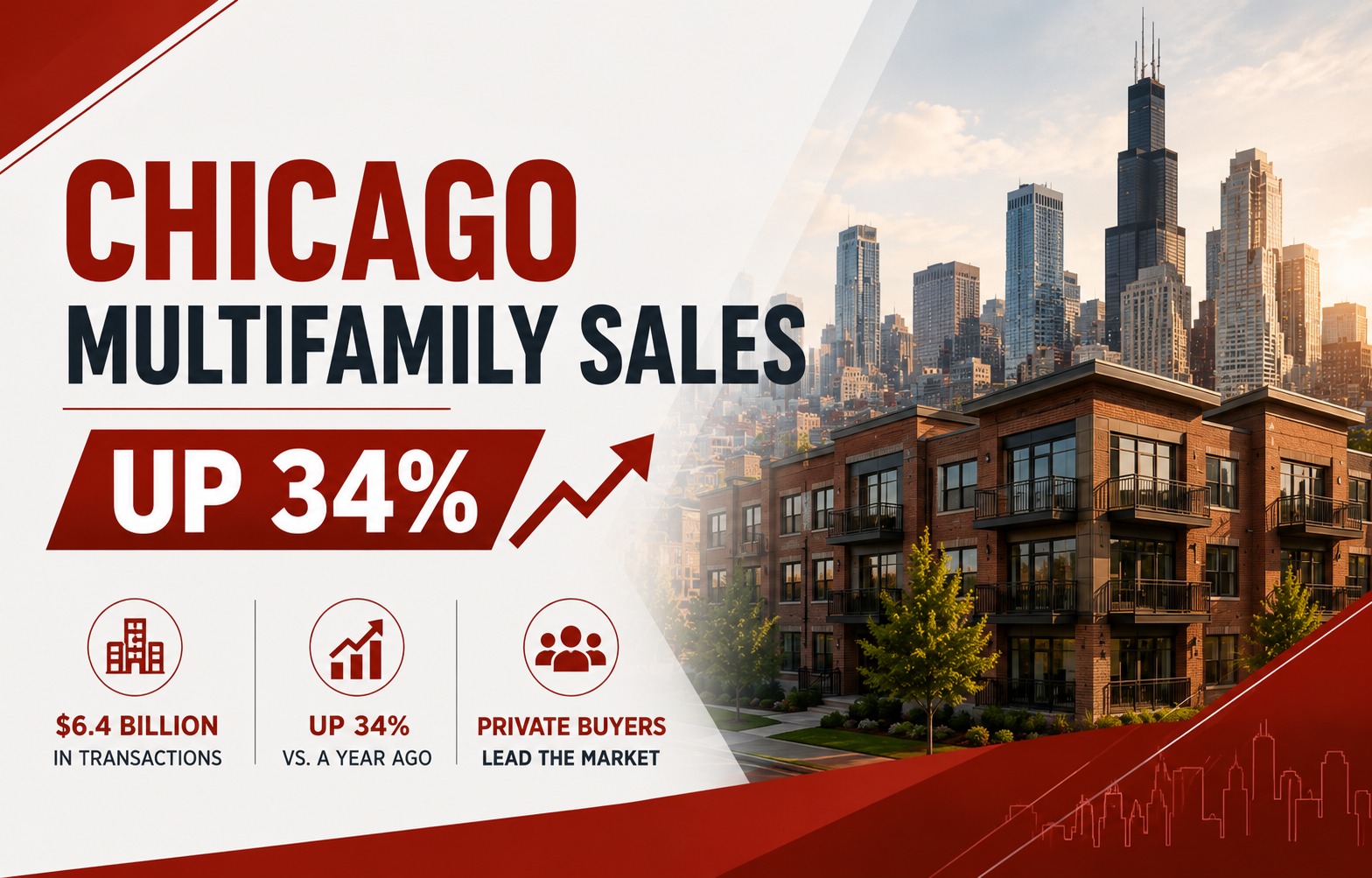
Chicago Multifamily Deal Volume Is Up 34%. Here’s What That Number Isn’t Telling You.
Chicago multifamily transaction volume hit $6.4 billion over the trailing twelve months, up 34% from a year earlier — a growth rate that far outpaced the national market, where deal volume barely moved, rising just 0.6% to roughly $125 billion, according to CoStar. Every broker in this city is going to send you that headline this month. Almost none of them are going to tell you what’s actually driving it, and that’s the part that determines whether this is your window or your warning.
The Number Everyone’s Quoting, and Why It’s Incomplete
A 34% jump sounds like a seller’s market snapping back. It isn’t, not uniformly. What it actually reflects is capital repositioning after two stalled years — buyers and sellers finally converging on price after 2023 and 2024 spent mostly in a standoff.
We sat across the table from three sellers last year who all made the same mistake: anchoring to their 2021 basis and refusing to move on price while buyers priced in higher debt costs. Deals died over 50-75 basis points of cap rate disagreement. What changed heading into 2026 isn’t that values recovered — it’s that both sides stopped waiting for the other to blink.
What’s Actually Fueling Chicago Multifamily Transaction Volume
Three forces are doing the real work behind that headline number, and an investor evaluating a hold-or-sell decision needs to understand which one applies to their asset.
Rate stabilization broke the standoff. Once financing costs stopped moving in unpredictable increments, underwriters on both sides could finally agree on a number. That alone unstuck a backlog of deals that had been sitting on the market for 12-18 months.
Private capital never left. Institutional buyers pulled back hard during the rate shock, but private buyers kept transacting the entire time. As of Q3 2025, private buyers accounted for roughly 65% of all Chicago multifamily transactions, with institutional groups remaining selective but active. That’s your buyer pool for anything under $10-15 million — and they’re not waiting for a Fed pivot to act.
The suburbs are where the transaction count actually lives. Downtown and the North Lakefront dominate the dollar volume — together they captured roughly 70% of total Chicago investment activity in Q3 2025 — but that’s a function of asset size, not where deals are actually happening. Look at the collar counties and the picture is different. In April 2026 alone, the Chicago MSA logged 175 multifamily transactions totaling $587.8 million, and the top submarkets by volume weren’t downtown at all — they were Elgin/Dundee, Downtown Elmhurst, and Southeast Lake County. If you own a 20-unit in DuPage or Will County, the relevant comp set isn’t the lakefront trophy sale making headlines — it’s your submarket’s own transaction pace, which is arguably healthier right now.
Where Pricing Actually Sits
Cap rates have not compressed back to 2021 levels, and anyone telling an owner otherwise is setting them up for a disappointing BOV. As of Q3 2025, Chicago multifamily cap rates averaged 6.7%, above the national level. Average pricing across the metro landed around $228,000 per unit by year-end 2025, and construction has stayed constrained enough — roughly 9,800 units underway entering Q1 2026, a limited pace of inventory expansion relative to market size — that supply isn’t the thing pressuring pricing downward.
What that combination tells you: volume is up because deals are clearing, not because valuations snapped back to peak. Sellers who need a 2021 number to make the math work are still going to be disappointed. Sellers who run their numbers against today’s 6.5-7% cap rate environment are going to find willing, capitalized buyers — often within 30-45 days, not the 6-9 months it took in 2023.
Five signs your asset is positioned to sell into this volume, not against it:
- Cap rate on trailing NOI is at or above 6.5% at current asking price — you’re not fighting the market, you’re pricing to it.
- Deferred maintenance is disclosed and priced into the ask, not hidden and discovered in diligence.
- Your submarket — Elgin, Elmhurst, Lake County, or similar — has active comps within the last 90 days, not stale 2022 sales.
- You’re not anchored to your original basis; you’re underwriting to today’s debt cost like your buyer will.
- Your T-12 and rent roll are clean and ready before you list, not assembled after the first LOI lands.
A Deal That Illustrates the Point
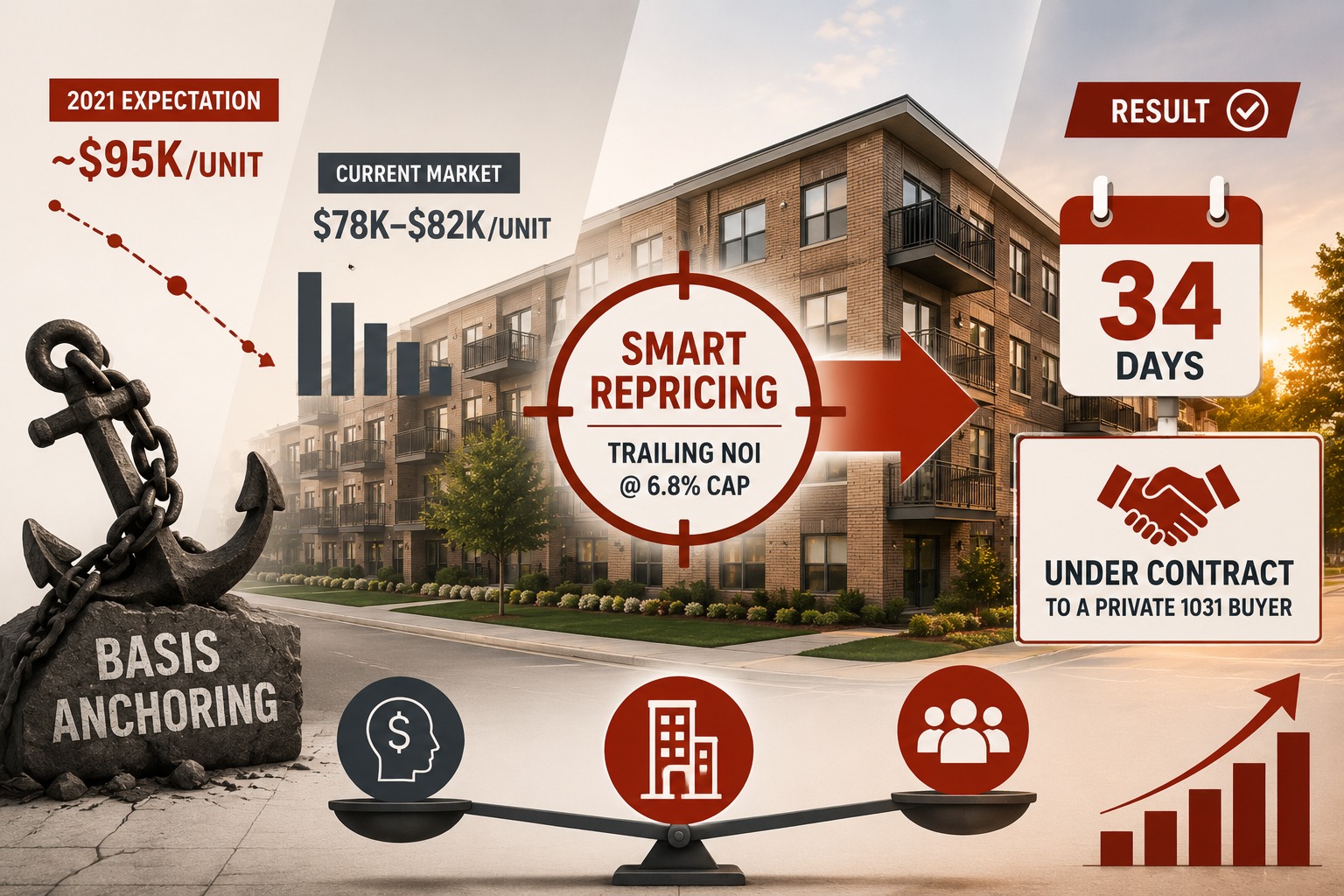
We worked with an owner on a 24-unit in the Elgin submarket earlier this year who almost didn’t list. He was convinced the building was worth what a similar property traded for in 2021, roughly $95,000/unit. Current comps in that submarket were closer to $78,000-82,000/unit.
Rather than sit and wait for a number that wasn’t coming back, we repriced to the trailing NOI at a 6.8% cap, which put us right in line with what buyers were actually underwriting to.
The property went under contract in 34 days to a private 1031 buyer who’d been circling the submarket for months, waiting for a seller to stop fighting the market.
Basis anchoring is the single most expensive mistake I watch owners make — the building doesn’t know what you paid for it, and neither does your buyer’s lender.
The Move Right Now
If you’re weighing a sale, don’t run your BOV against downtown comps if your asset is in the collar counties — the submarket-level data tells a more accurate story than the metro headline, and right now it’s telling you buyers are active and capitalized in Elgin, Elmhurst, and southern Lake County specifically. If you’re buying, the private-capital pool you’re competing against is deep, so pre-underwriting before a property hits the market — not after — is what actually wins deals in a 30-45 day window.
Volume recovering before pricing fully resets is a specific, narrow phase of the cycle. It rewards sellers who move now and buyers who’ve already done their underwriting homework. It punishes anyone still waiting for a number that isn’t coming back.
If you’re weighing a sale or an acquisition in the Chicago suburbs right now, the math is worth running before the market decides the timing for you.